import numpy as np
import matplotlib.pyplot as plt

rng = np.random.default_rng(237)

# ---- timing parameters ----
dt_imu  = 0.01       # IMU at 100 Hz
dt_cam  = 0.05       # camera at 20 Hz (every 5 IMU steps)
T_total = 20.0       # seconds
n_imu   = int(T_total / dt_imu)   # 2000 IMU steps
cam_period = int(dt_cam / dt_imu) # 5 IMU steps between camera measurements

# ---- noise parameters ----
sigma_a  = 0.05      # IMU accelerometer noise (m/s^2 per step sqrt)
sigma_b  = 0.002     # bias random walk noise
sigma_cam = 0.05     # camera position noise (m)

R_a   = (sigma_a**2) * np.eye(3)      # shape (3, 3)
Q_b   = (sigma_b**2) * np.eye(3)      # shape (3, 3)
R_cam = (sigma_cam**2) * np.eye(3)    # shape (3, 3)

# ---- ground truth trajectory: sinusoidal motion ----
t_imu  = np.linspace(0, T_total, n_imu + 1)   # shape (2001,)
p_true = np.zeros((n_imu + 1, 3))             # shape (2001, 3)
v_true = np.zeros((n_imu + 1, 3))
a_true = np.zeros((n_imu + 1, 3))

omega_traj = 0.4     # trajectory frequency (rad/s)
p_true[:, 0] = np.sin(omega_traj * t_imu)
p_true[:, 1] = 0.5 * np.cos(omega_traj * t_imu)
p_true[:, 2] = 0.1 * t_imu
v_true[:, 0] =  omega_traj * np.cos(omega_traj * t_imu)
v_true[:, 1] = -0.5 * omega_traj * np.sin(omega_traj * t_imu)
v_true[:, 2] =  0.1 * np.ones(n_imu + 1)
a_true[:, 0] = -omega_traj**2 * np.sin(omega_traj * t_imu)
a_true[:, 1] = -0.5 * omega_traj**2 * np.cos(omega_traj * t_imu)
a_true[:, 2] =  np.zeros(n_imu + 1)

# Inject a constant accelerometer bias
b_true = np.array([0.08, -0.05, 0.03])   # shape (3,) -- true bias

# ---- simulate IMU measurements ----
imu_meas = np.zeros((n_imu, 3))           # shape (2000, 3)
for k in range(n_imu):
    imu_meas[k] = (a_true[k] + b_true
                   + rng.normal(0, sigma_a, 3))   # shape (3,)

# ---- state-space matrices ----
# State: [p(3), v(3), b_a(3)] = 9D
n_state = 9
dt = dt_imu

# Transition matrix F (given a_tilde as control input)
F = np.eye(n_state)                               # shape (9, 9)
F[0:3, 3:6] = dt * np.eye(3)                      # p += dt * v
F[0:3, 6:9] = -0.5 * dt**2 * np.eye(3)           # p -= dt^2/2 * b_a
F[3:6, 6:9] = -dt * np.eye(3)                     # v -= dt * b_a

# Control matrix B (maps a_tilde measurement to state)
B = np.zeros((n_state, 3))                        # shape (9, 3)
B[0:3, :] = 0.5 * dt**2 * np.eye(3)               # p contribution
B[3:6, :] = dt * np.eye(3)                        # v contribution

# Process noise covariance
Q = np.zeros((n_state, n_state))                  # shape (9, 9)
Q[0:3, 0:3] = (0.5 * dt**2)**2 * R_a
Q[3:6, 3:6] = dt**2 * R_a
Q[0:3, 3:6] = 0.5 * dt**3 * R_a
Q[3:6, 0:3] = 0.5 * dt**3 * R_a
Q[6:9, 6:9] = Q_b

# Camera observation matrix (measures position only)
H_cam = np.zeros((3, n_state))                    # shape (3, 9)
H_cam[0:3, 0:3] = np.eye(3)

# ---- Standard (covariance-form) EKF ----
x_hat_cov  = np.zeros((n_imu + 1, n_state))       # shape (2001, 9)
x_hat_cov[0, :3] = p_true[0] + rng.normal(0, 0.1, 3)   # noisy initial position
x_hat_cov[0, 3:6] = v_true[0]
x_hat_cov[0, 6:9] = np.zeros(3)                   # assume zero initial bias estimate

P_cov = np.diag([0.1**2]*3 + [0.5**2]*3 + [0.1**2]*3)   # shape (9, 9)

rmse_cov = np.zeros(n_imu)
rmse_dr  = np.zeros(n_imu)

# Dead-reckoning only (no camera updates, no bias)
p_dr = p_true[0].copy()
v_dr = v_true[0].copy()

for k in range(n_imu):
    a_input = imu_meas[k]             # shape (3,)

    # ---- Predict (covariance form) ----
    x_pred = F @ x_hat_cov[k] + B @ a_input   # shape (9,)
    P_pred = F @ P_cov @ F.T + Q              # shape (9, 9)

    # ---- Dead-reckoning (no filter) ----
    p_dr += dt * v_dr + 0.5 * dt**2 * a_input
    v_dr += dt * a_input
    rmse_dr[k] = np.linalg.norm(p_dr - p_true[k + 1])

    # ---- Camera update (every cam_period IMU steps) ----
    if (k + 1) % cam_period == 0:
        y_cam = p_true[k + 1] + rng.normal(0, sigma_cam, 3)   # shape (3,)
        S  = H_cam @ P_pred @ H_cam.T + R_cam                  # shape (3, 3)
        K  = P_pred @ H_cam.T @ np.linalg.inv(S)               # shape (9, 3)
        nu = y_cam - H_cam @ x_pred                             # shape (3,)
        x_hat_cov[k + 1] = x_pred + K @ nu
        P_cov = (np.eye(n_state) - K @ H_cam) @ P_pred
    else:
        x_hat_cov[k + 1] = x_pred
        P_cov = P_pred

    rmse_cov[k] = np.linalg.norm(x_hat_cov[k + 1, :3] - p_true[k + 1])

# ---- Information-form filter (same measurements, different update equations) ----
x_hat_inf = np.zeros((n_imu + 1, n_state))
x_hat_inf[0] = x_hat_cov[0].copy()

P0_inf = np.diag([0.1**2]*3 + [0.5**2]*3 + [0.1**2]*3)
Omega  = np.linalg.inv(P0_inf)        # shape (9, 9)
eta    = Omega @ x_hat_inf[0]         # shape (9,)

rmse_inf = np.zeros(n_imu)

for k in range(n_imu):
    a_input = imu_meas[k]

    # ---- Predict (information form: convert, propagate, convert back) ----
    P_cur  = np.linalg.inv(Omega)     # shape (9, 9)
    x_cur  = np.linalg.solve(Omega, eta)   # shape (9,)
    x_pred = F @ x_cur + B @ a_input
    P_pred = F @ P_cur @ F.T + Q

    # ---- Camera update (information form: additive) ----
    if (k + 1) % cam_period == 0:
        y_cam  = p_true[k + 1] + rng.normal(0, sigma_cam, 3)
        R_inv  = np.linalg.inv(R_cam)                           # shape (3, 3)
        Omega_pred = np.linalg.inv(P_pred)
        eta_pred   = Omega_pred @ x_pred
        # Information update: additive
        Omega = Omega_pred + H_cam.T @ R_inv @ H_cam            # shape (9, 9)
        eta   = eta_pred   + H_cam.T @ R_inv @ y_cam            # shape (9,)
    else:
        Omega = np.linalg.inv(P_pred)
        eta   = Omega @ x_pred

    x_hat_inf[k + 1] = np.linalg.solve(Omega, eta)
    rmse_inf[k] = np.linalg.norm(x_hat_inf[k + 1, :3] - p_true[k + 1])

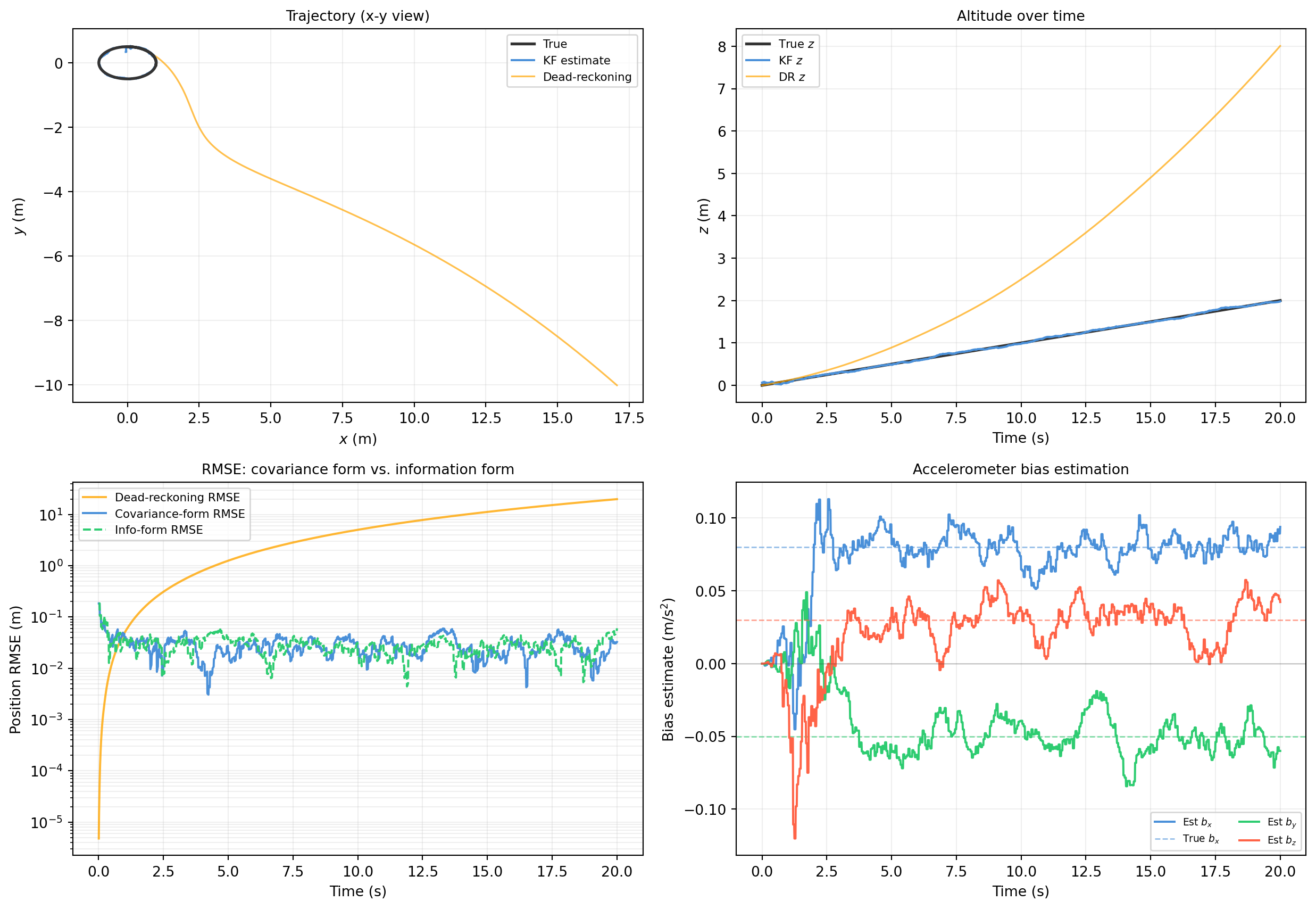
# ---- Plot ----
t_steps = t_imu[1:]   # shape (2000,)

fig, axes = plt.subplots(2, 2, figsize=(13, 9))

# Top-left: 3D trajectory projection (x-y)
ax = axes[0, 0]
ax.plot(p_true[:, 0], p_true[:, 1],
        color='#333333', lw=2.0, label='True', zorder=5)
ax.plot(x_hat_cov[:, 0], x_hat_cov[:, 1],
        color='#4a90d9', lw=1.5, label='KF estimate', zorder=4)
# Dead-reckoning: recompute trajectory
p_dr_hist = np.zeros((n_imu + 1, 3))
v_dr_hist = np.zeros((n_imu + 1, 3))
p_dr_hist[0] = p_true[0]
v_dr_hist[0] = v_true[0]
for k in range(n_imu):
    p_dr_hist[k+1] = p_dr_hist[k] + dt*v_dr_hist[k] + 0.5*dt**2*imu_meas[k]
    v_dr_hist[k+1] = v_dr_hist[k] + dt*imu_meas[k]
ax.plot(p_dr_hist[:, 0], p_dr_hist[:, 1],
        color='orange', lw=1.2, alpha=0.7, label='Dead-reckoning', zorder=3)
ax.set_xlabel('$x$ (m)')
ax.set_ylabel('$y$ (m)')
ax.legend(fontsize=8)
ax.grid(alpha=0.2)
ax.set_title('Trajectory (x-y view)', fontsize=10)

# Top-right: z vs time
ax = axes[0, 1]
ax.plot(t_imu, p_true[:, 2], color='#333333', lw=2, label='True $z$')
ax.plot(t_imu, x_hat_cov[:, 2], color='#4a90d9', lw=1.5, label='KF $z$')
ax.plot(t_imu, p_dr_hist[:, 2], color='orange', lw=1.2, alpha=0.7, label='DR $z$')
ax.set_xlabel('Time (s)')
ax.set_ylabel('$z$ (m)')
ax.legend(fontsize=8)
ax.grid(alpha=0.2)
ax.set_title('Altitude over time', fontsize=10)

# Bottom-left: position RMSE comparison
ax = axes[1, 0]
ax.semilogy(t_steps, rmse_dr,  color='orange', lw=1.5, alpha=0.8, label='Dead-reckoning RMSE')
ax.semilogy(t_steps, rmse_cov, color='#4a90d9', lw=1.5, label='Covariance-form RMSE')
ax.semilogy(t_steps, rmse_inf, color='#2ecc71', lw=1.5, ls='--', label='Info-form RMSE')
ax.set_xlabel('Time (s)')
ax.set_ylabel('Position RMSE (m)')
ax.legend(fontsize=8)
ax.grid(alpha=0.2, which='both')
ax.set_title('RMSE: covariance form vs. information form', fontsize=10)

# Bottom-right: bias estimate convergence
ax = axes[1, 1]
colors_b = ['#4a90d9', '#2ecc71', 'tomato']
axes_labels = ['x', 'y', 'z']
for i in range(3):
    ax.plot(t_imu, x_hat_cov[:, 6 + i],
            color=colors_b[i], lw=1.5, label=f'Est $b_{{{axes_labels[i]}}}$')
    ax.axhline(b_true[i], color=colors_b[i], lw=1.0, ls='--', alpha=0.6,
               label=f'True $b_{{{axes_labels[i]}}}$' if i == 0 else None)
ax.axhline(0, color='#333333', lw=0.4, alpha=0.5)
ax.set_xlabel('Time (s)')
ax.set_ylabel('Bias estimate (m/s$^2$)')
ax.legend(fontsize=7, ncol=2)
ax.grid(alpha=0.2)
ax.set_title('Accelerometer bias estimation', fontsize=10)

plt.tight_layout()
plt.show()

print(f"Final position RMSE -- dead-reckoning:      {rmse_dr[-1]:.3f} m")
print(f"Final position RMSE -- covariance-form KF:  {rmse_cov[-1]:.4f} m")
print(f"Final position RMSE -- information-form KF: {rmse_inf[-1]:.4f} m")
print(f"True bias: {b_true}")
print(f"Est. bias (cov-form, final): {x_hat_cov[-1, 6:9].round(4)}")