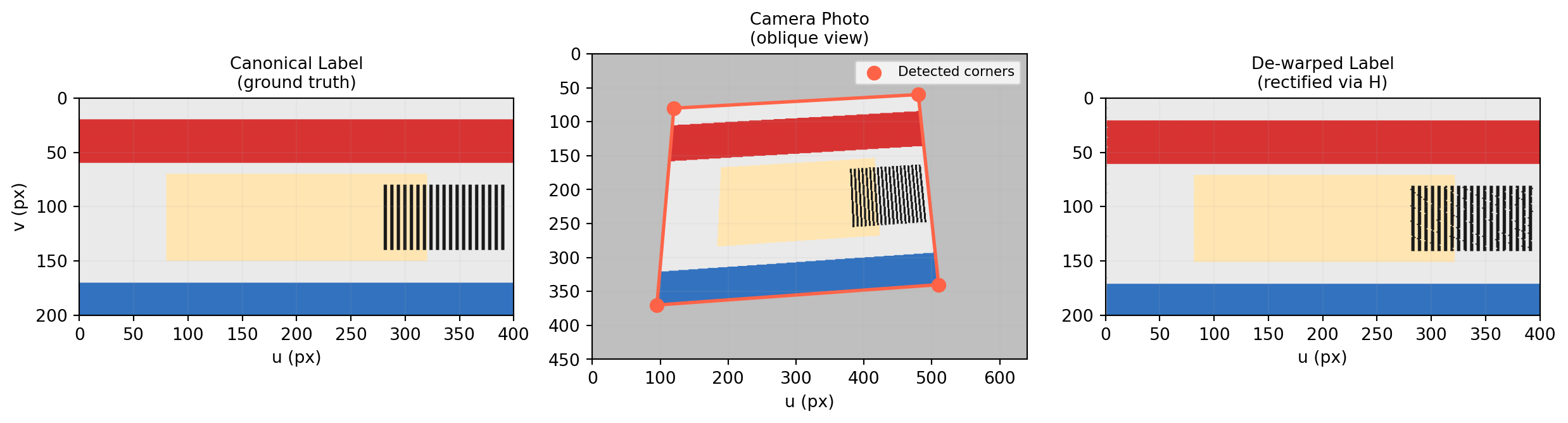
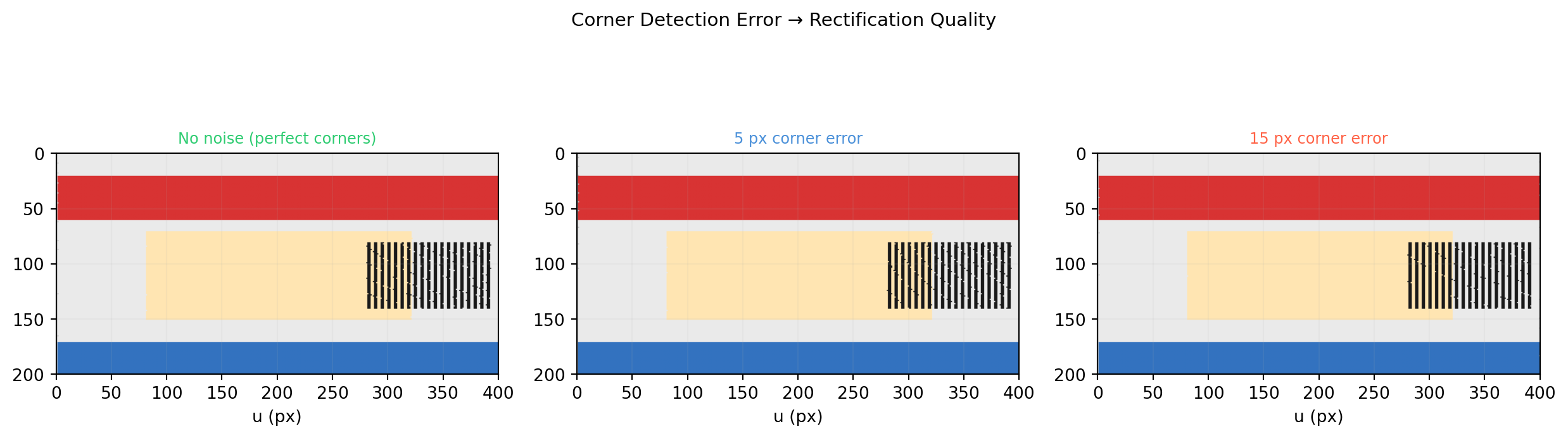
import numpy as np

def dlt_homography(src, dst):
    """DLT homography estimate. src,dst: shape (n,2). Returns H: (3,3)."""
    n = len(src)
    A = np.zeros((2*n, 9))
    for i, ((x,y),(u,v)) in enumerate(zip(src, dst)):
        A[2*i  ] = [-x,-y,-1, 0, 0, 0, u*x, u*y, u]
        A[2*i+1] = [ 0, 0, 0,-x,-y,-1, v*x, v*y, v]
    _, _, Vt = np.linalg.svd(A)
    H = Vt[-1].reshape(3, 3)
    return H / H[2, 2]

def reproj_errors(H, src, dst):
    """Per-point reprojection errors. Returns shape (n,)."""
    n = len(src)
    src_h = np.column_stack([src, np.ones(n)])   # shape (n, 3)
    proj  = (H @ src_h.T).T                       # shape (n, 3)
    pred  = proj[:, :2] / proj[:, 2:3]            # shape (n, 2)
    return np.linalg.norm(pred - dst, axis=1)      # shape (n,)

def ransac_homography(src, dst, max_iter=500, threshold=3.0, rng=None):
    """
    RANSAC homography estimation.
    src, dst:   shape (n, 2)
    threshold:  inlier reprojection error in pixels
    Returns (H_best, inlier_mask): H shape (3,3), mask shape (n,) bool.
    """
    if rng is None:
        rng = np.random.default_rng(0)
    n = len(src)
    best_inliers = np.zeros(n, dtype=bool)
    best_count   = 0

    for _ in range(max_iter):
        idx   = rng.choice(n, size=4, replace=False)
        H_try = dlt_homography(src[idx], dst[idx])        # shape (3, 3)
        errs  = reproj_errors(H_try, src, dst)            # shape (n,)
        mask  = errs < threshold                          # shape (n,) bool

        if mask.sum() > best_count:
            best_count   = mask.sum()
            best_inliers = mask

    # Refit on all inliers
    H_final = dlt_homography(src[best_inliers], dst[best_inliers])
    return H_final, best_inliers

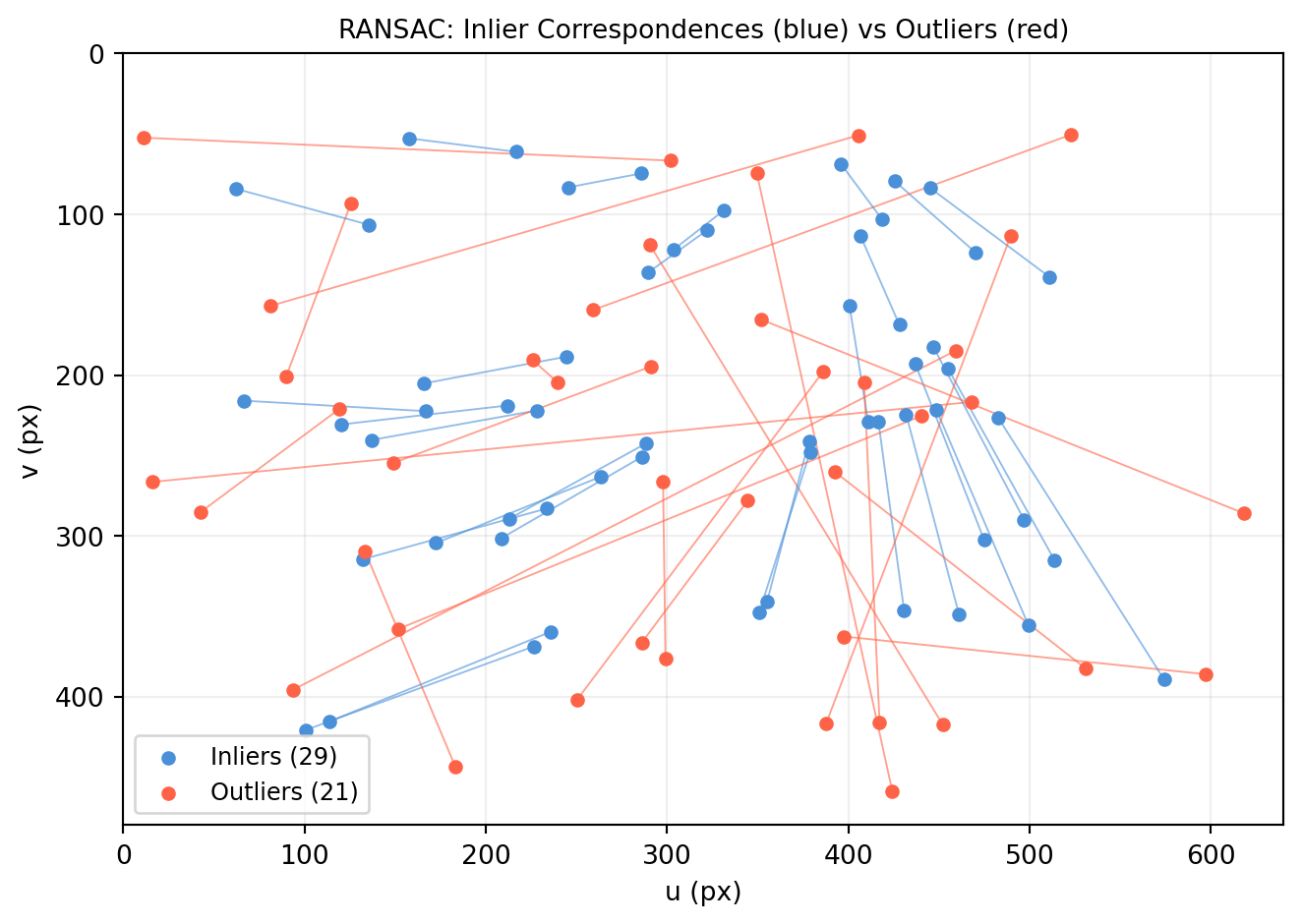
# --- Simulation: 50 matches, 40% outliers ---
rng = np.random.default_rng(42)

# Ground-truth H
H_true = np.array([[ 1.2, 0.3, 50.],
                   [-0.1, 1.1, 30.],
                   [ 0.001, 0.0005, 1.]])   # shape (3, 3)
H_true /= H_true[2, 2]

# Generate 50 source points (random pixel locations)
n_pts   = 50
src_all = rng.uniform([50., 50.], [590., 430.], (n_pts, 2))   # shape (50, 2)

# True destination points
src_h   = np.column_stack([src_all, np.ones(n_pts)])
proj    = (H_true @ src_h.T).T
dst_all = proj[:, :2] / proj[:, 2:3]   # shape (50, 2)

# Add small inlier noise
inlier_noise = rng.normal(0., 1.0, (n_pts, 2))   # shape (50, 2)
dst_all += inlier_noise

# Corrupt 40% of matches with random outliers
n_outliers = int(0.4 * n_pts)
outlier_idx = rng.choice(n_pts, size=n_outliers, replace=False)
dst_all[outlier_idx] = rng.uniform([0., 0.], [640., 480.], (n_outliers, 2))

# Run plain DLT (no RANSAC) and RANSAC
H_dlt, _  = np.linalg.svd(  # DLT on all points
    np.vstack([[-x,-y,-1,0,0,0,u*x,u*y,u] for (x,y),(u,v) in zip(src_all, dst_all)]
            + [[0,0,0,-x,-y,-1,v*x,v*y,v] for (x,y),(u,v) in zip(src_all, dst_all)])), 2
A = np.zeros((2*n_pts, 9))
for i, ((x,y),(u,v)) in enumerate(zip(src_all, dst_all)):
    A[2*i  ] = [-x,-y,-1, 0, 0, 0, u*x, u*y, u]
    A[2*i+1] = [ 0, 0, 0,-x,-y,-1, v*x, v*y, v]
_, _, Vt = np.linalg.svd(A)
H_dlt = Vt[-1].reshape(3, 3); H_dlt /= H_dlt[2,2]

H_ransac, inlier_mask = ransac_homography(src_all, dst_all, max_iter=500,
                                          threshold=3.0, rng=rng)

def rms_on_inliers(H, src, dst, mask):
    errs = reproj_errors(H, src[mask], dst[mask])
    return np.sqrt(np.mean(errs**2))

print(f"Points: {n_pts}  |  Outliers: {n_outliers} ({100*n_outliers/n_pts:.0f}%)")
print(f"Plain DLT  — RMS error (inliers only): "
      f"{rms_on_inliers(H_dlt,   src_all, dst_all, ~np.isin(np.arange(n_pts), outlier_idx)):.2f} px")
print(f"RANSAC     — inliers found: {inlier_mask.sum()}/{n_pts}")
print(f"           — RMS error (inliers only): "
      f"{rms_on_inliers(H_ransac, src_all, dst_all, ~np.isin(np.arange(n_pts), outlier_idx)):.2f} px")